
Crypto arbitrage: the same coin, priced differently on 11 exchanges
Every few minutes, hundreds of USDT pairs trade at slightly different prices on different exchanges. Most of those gaps are fiction — stale quotes, mismatched tickers, fees bigger than the spread. PROVISUM walks the real order books on 11 derivatives venues and 6 spot venues and shows only what survives. This page shows what that actually looks like, with real screenshots and dated numbers.
What is cross-venue crypto arbitrage?
The same asset — say the ONG perpetual — has an independent order book on Bybit and on MEXC. When Bybit’s best bid rises above MEXC’s best ask, you can sell on one and buy on the other in the same moment and collect the difference. No price prediction is involved; the position is flat the instant both legs fill. The catch is everything after the word “when”: fees on both legs, how much size the books actually hold, and — for perpetuals — the funding the position pays or earns while you hold it.
What profits are actually possible?
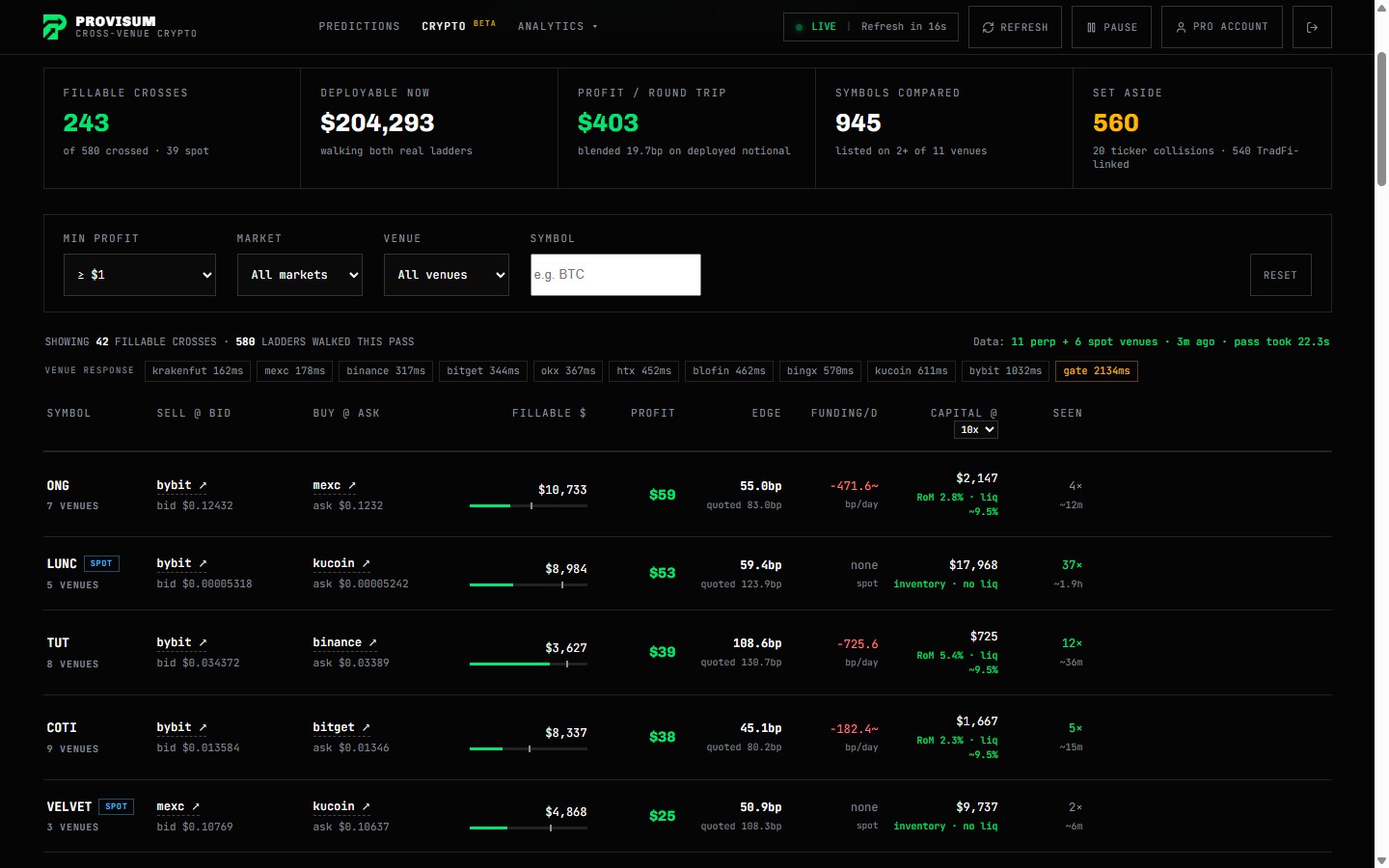
Measured on a single live pass on 29 August 2026, 21:18 UTC — not a projection:
- 945 symbols listed on two or more of 11 venues; 580 crossed at top of book; 243 still cleared both venues’ taker fees after walking the real ladders (39 of them on spot markets).
- Those 243 edges totalled ≈$403 of round-trip profit on ≈$204,000 of deployable notional — a blended ~20bp per round trip.
- Individual edges typically pay $1–$70 per round trip at 10–140bp, on fillable sizes from a few hundred dollars to ~$20k. The largest on this pass: ONG at $59 on $10,733 (55bp, Bybit→MEXC) and a spot edge, LUNC, at $53 on $8,984 (59bp, Bybit→KuCoin).
- Concentration is the rule: the top three symbols carried 38% of all profit on this pass. Most fillable crosses are under $5.
Three honesty notes that most arbitrage marketing omits. First, these are snapshots: the board rebuilds every 3 minutes and an edge depletes when someone takes it, so per-pass totals cannot be multiplied into a monthly figure. Second, everything above assumes both legs fill at the displayed prices simultaneously — displayed size is resting orders, and whether it honours a real order is unproven until one is sent. Third, the majors have no arbitrage: BTC and ETH quote within 1–2bp across all 11 venues, several bp short of covering two taker fees. That is the market working, and any scanner showing you a fat BTC arb is showing you an artifact.
What eats the headline spread?
A real example from the board, reconstructed to the cent. TUT quoted a 151.6bp gross gap at top of book — $70.32 on the $4,638 that fit. What a naive scanner shows. What survived:
- − taker fees, per venue (they differ: MEXC 2bp, Binance/OKX/Gate 5bp, Bybit 5.5bp, Bitget/KuCoin/Blofin/HTX 6bp): −10.5bp → $4.87.
- − ladder depth: the top level doesn’t hold $4,638, so the fill walks into worse prices on both books: −17.4bp → $8.07.
- = $57.37 actually collectable — 19% below the headline. Every profit figure on the board carries this decomposition on hover.
Then the clock starts. A perpetual hedge pays or receives funding while held: the short leg earns its venue’s rate, the long leg pays its venue’s. On the same pass, one otherwise-attractive edge showed funding of −706bp per day — it would have consumed its own 124bp edge within five hours of holding. The board prints funding per day on every perp row precisely because of rows like that. And leverage does not change any of these numbers: book depth caps the dollar profit; leverage only shrinks the margin you post and pulls liquidation closer.
Perpetuals vs spot arbitrage
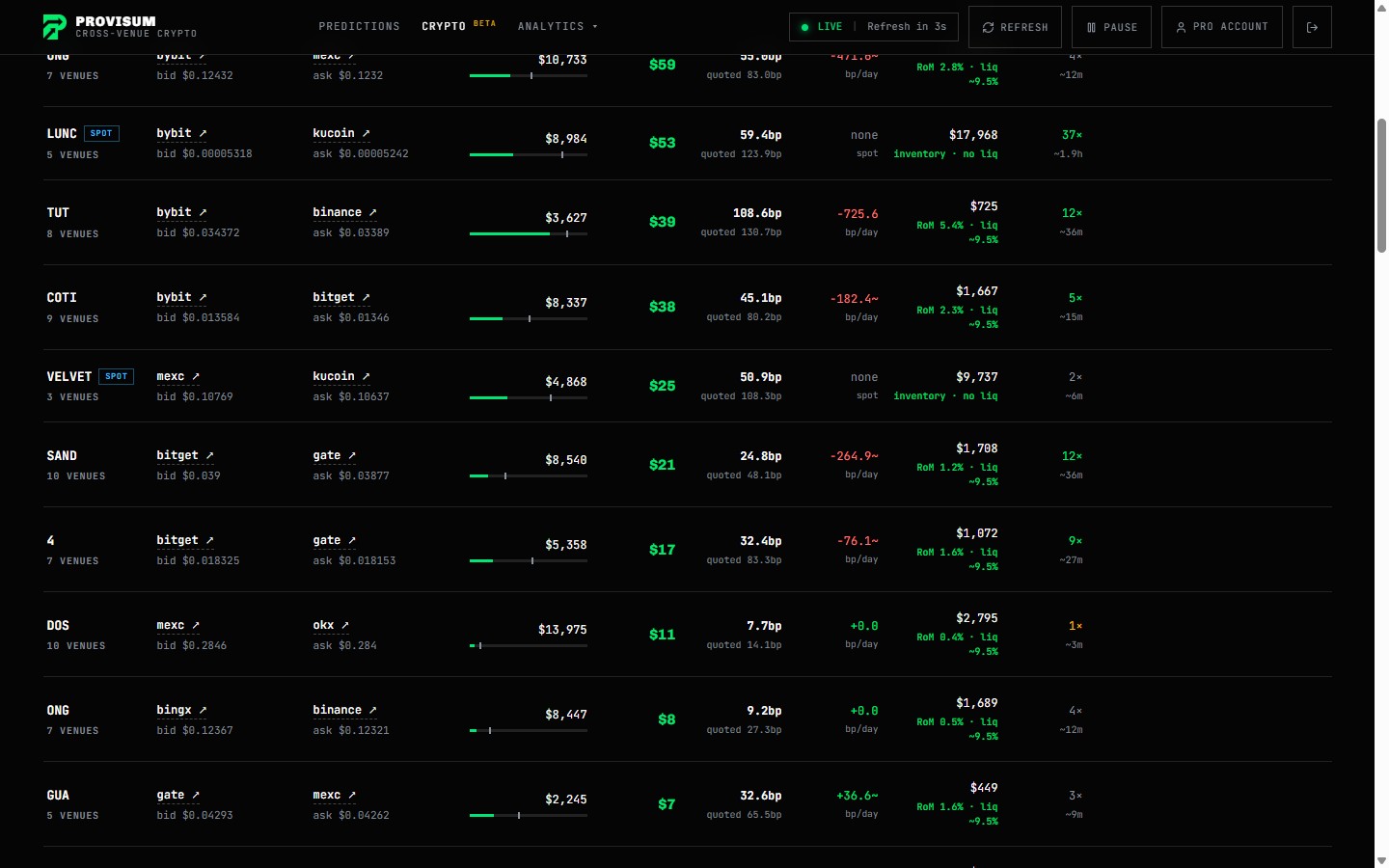
Perpetual futures settle in USDT on both legs, so one account per venue and margin is all you need — but the position carries funding (either direction) and, with leverage, liquidation risk: a liquidated leg turns a hedge into a naked position. Spot has neither funding nor liquidation, but settlement needs the coins already sitting on the venue where you sell and USDT where you buy — an on-chain transfer usually takes longer than the cross lasts, so spot arbitrage in practice means holding inventory on both venues and rebalancing.
Why most crypto arbitrage scanners mislead
- Top-of-book edges. Quoting the best bid/ask says nothing about size. On our measurements, walking real ladders erases roughly a third of apparent opportunities entirely.
- Ticker collisions. The same symbol is a different asset on different venues — we measured “BB” trading 891% apart on two exchanges. A scanner without an identity guard reports that as the trade of the year.
- Ignored fees, uniform fees. Two taker fees are 4–12bp depending on the venue pair. A flat assumption both hides real edges and invents fake ones.
- Weekend “edges” on tokenized stocks. Perps on equities and indices drift apart while the underlying market is closed — it looks like the strongest signal on the board and is uncloseable. We exclude ~540 TradFi-linked tickers outright.
How PROVISUM does it
Every ~3 minutes: snapshot 11 derivatives venues and 6 spot venues concurrently, reject ticker collisions and TradFi-linked perps, find every crossing venue pair per symbol (net of each venue’s own taker fee), then walk both real order books for every single candidate — nothing is sampled. Each row shows the venue-linked prices it was built from, the notional that fills, the profit with its full decomposition, funding per day, capital at your chosen leverage, and how many consecutive passes the edge has survived.
See the live gaps
PROVISUM scans Polymarket, Kalshi, PredictIt and Limitless every 10 minutes and surfaces the cross-venue hedges that are actually on the board right now — fee-adjusted, depth-checkable, honestly labeled.
All figures are dated measurements from the pass named above, gross of slippage beyond the visible book, withdrawal costs and taxes; they assume simultaneous fills, which is unproven. Nothing here is financial advice — see the full disclaimer.
Keep reading: Prediction market arbitrage: the complete guide · Polymarket vs Kalshi: fees, access & price gaps · Polymarket arbitrage: finding mispriced markets · Oracle risk: when both legs of a hedge lose · Liquidity: why the quoted edge is not the real one